Ages 3–6 · Casa — where children build independence, focus, and a lifelong love of learning.
“Help me to do it by myself!” — this heartfelt desire expressed by the young child was a key discovery in Dr. Maria Montessori’s research. She recognized the child’s innate yearning for independence, and the importance of offering the right amount and right type of support to nurture it.
Montessori-trained teachers are specially equipped to respond to this need, creating environments and interactions that foster confidence, autonomy, and self-discovery. Our bright, prepared Casa environment supports whole-child development from 18 months through 6 years, with key areas in practical life, sensorial, math, language, and geography/nature.
.png)
From practical life to early math and language — the hands-on heart of the Casa.
Our toddler environment is carefully designed to engage the child’s learning spirit, offering a rich variety of experiences that support the natural process of becoming independent. Through observation, exploration, and practice, toddlers master new skills and develop confidence in their own abilities.
These activities refine motor skills and coordination while building purpose, belonging, and achievement. We also partner closely with families — through seminars, workshops, and optional home visits — to extend a Montessori-friendly environment into the home and help each child become a calm, focused, self-directed learner.

One of the most important areas of the Casa classroom and the first explored by a young child. Practical-life activities are inspired by real-life tasks children observe at home — pouring, laundry washing, ironing, polishing, scrubbing, and baking.
These activities build belonging and purpose, developing self-esteem, confidence, coordination, concentration, independence, and responsibility — and lay the foundation for math and logic by fostering order and reasoning.

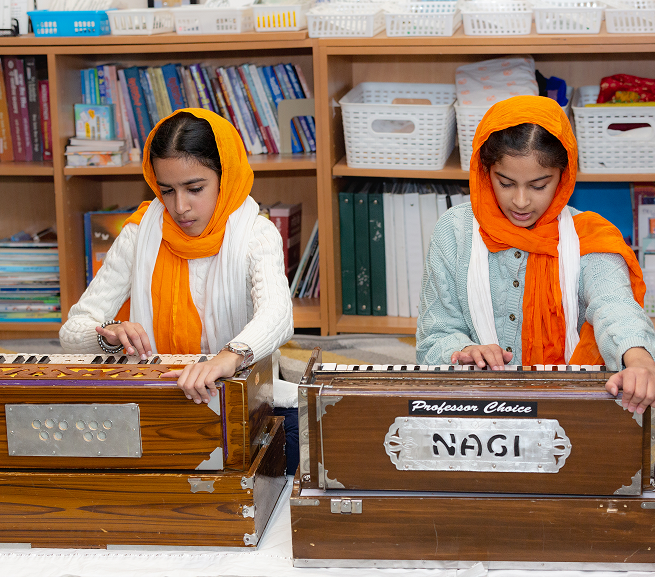
Sensorial activities refine the child’s senses — visual, tactile, olfactory, gustatory, and auditory. Each material isolates a single sense so children focus and learn through direct experience, such as tasting bottles, sound cylinders, and the pink tower.
Children explore their senses and develop a deeper understanding of the world through touch, smell, sound, taste, and sight.

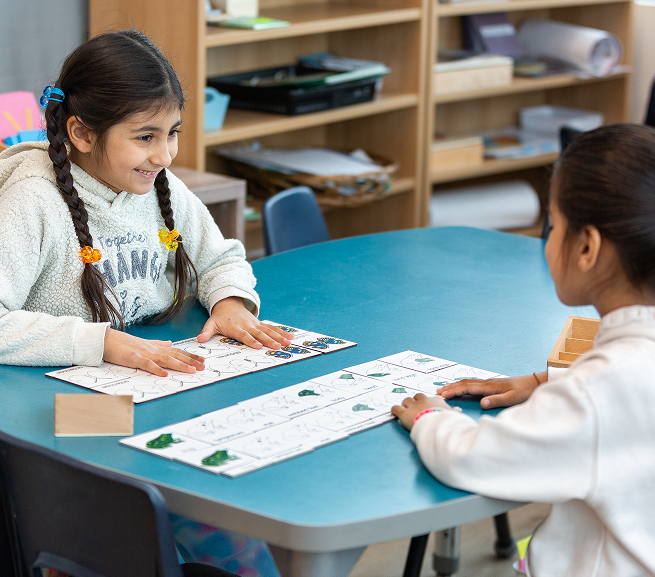
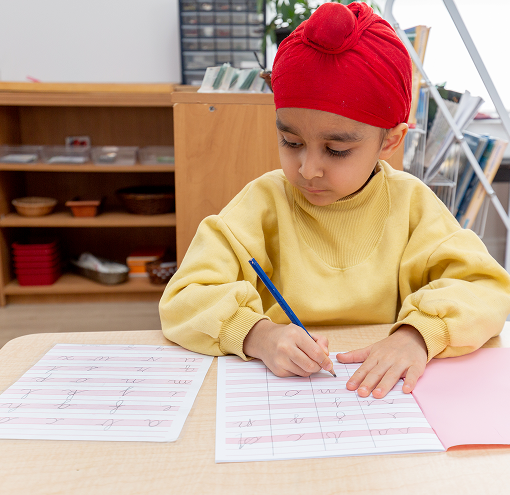
The language area inspires a love for reading and writing. Children begin with spoken language and classified cards, building rich vocabulary around art, instruments, animals, and countries. They progress through sandpaper letters (tracing cursive letters while saying their sounds), the moveable alphabet (forming words before writing), and metal insets (strengthening hand and wrist muscles).
By the time children write with pencils on lined paper, they have the stamina and coordination to write with ease — following a clear progression from sounds to words, and from phonetic reading to books and beyond.

Montessori math moves from concrete to abstract. Children recognize numbers through hands-on materials before written symbols — physically experiencing that 3 is smaller than 7 before learning the numerals.
They are introduced to numbers to ten, teens and tens, the decimal system, simple fractions, four-digit numbers, and basic operations — all through concrete materials that bring math to life and build a solid conceptual foundation.


.png)


Predictable routines give young children security — and long uninterrupted blocks for deep work.
Children are greeted individually, hang up their belongings, and ease into the morning with a chosen activity.
An uninterrupted block where children freely choose practical life, sensorial, language, and math work — building focus and independence.
Songs, stories, grace and courtesy lessons, and cultural studies bring the community together.
Fresh air, gross-motor play, and a calm, social lunch where children practise care of self.
Quiet rest for younger children, with enrichment activities and a gentle close to the day.
A rich, balanced curriculum that grows the whole child — mind, hands, and heart.
Pouring, buttoning, and care of the environment build coordination and independence.
Materials that refine the senses and prepare the mind for math and language.
Phonics, sandpaper letters, and rich vocabulary lay the foundation for reading and writing.
Concrete materials make counting, the decimal system, and operations tangible.
Geography, botany, zoology, and simple science spark wonder.
Early exposure to French through songs, games, and everyday vocabulary.
Gardening, nature walks, and active play on our 2-acre site.
Creative expression through painting, crafts, singing, and movement.