Grades 1–3 · Ages 6–9 — where curiosity becomes the great work of the imagination.
The elementary development years mark a great transformation in the child. At this stage, children are eager to explore society and the world, understand right from wrong, and discover meaningful roles within their community.
The Elementary Directress helps guide the child toward discovering answers to life’s BIG questions. While children receive individual lessons in all academic areas, they are also encouraged to develop their own methods of research and independent inquiry — the whole world is opened up to them in a safe, nurturing environment.
“Going-outs” are encouraged — where a child or a small group arrange to leave the classroom to learn more about a topic they are exploring. Academically, students often surpass the expectations of the Ontario Curriculum while developing valuable soft skills such as organization, time management, and networking.

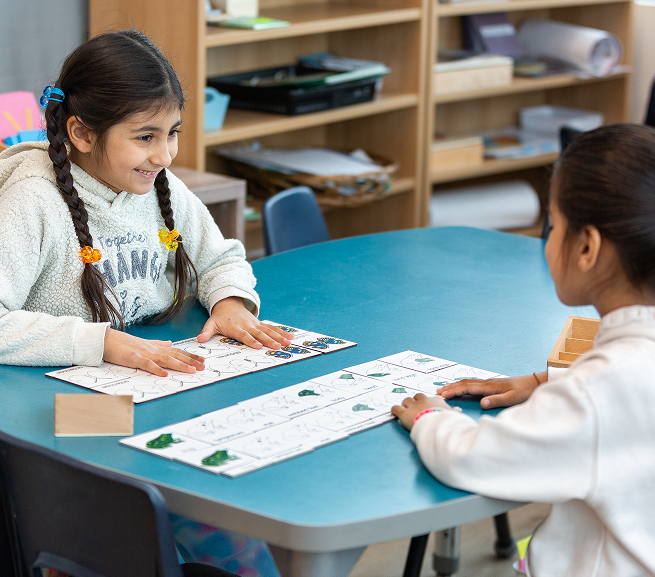
A rich, interconnected curriculum that opens the whole world to the child.
Elementary students are in a stage of reasoning and are naturally curious about language — its structure, relationships, and purpose. The Montessori language curriculum explores word studies such as antonyms, synonyms, homonyms, root words, and compound words. Words are presented as living entities that grow, evolve, and form families.
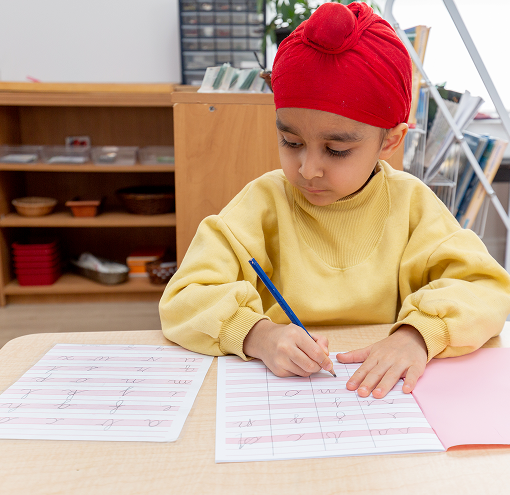
Materials are designed to isolate key concepts so children focus on one part of speech at a time. Grammar boxes begin with foundational concepts like nouns and gradually expand to sentence analysis and critical-thinking activities using hands-on manipulatives. Reading of all kinds is encouraged, and students engage in creative writing, poetry, and novel studies.

Mathematics in Montessori is a deeply sensorial experience. As Dr. Maria Montessori said, “What the hand does, the mind remembers.” Students use tactile materials to understand size, quantity, and patterning.
They gradually move from concrete manipulation to abstract understanding, ensuring each child’s unique learning style is accommodated and supported.

Cultural studies help children understand how everything in the world is interconnected and where they fit into it. Geography focuses on how people live, form societies, and adapt to their environments — beginning with themselves and the world around them through maps, continents, animals, and global traditions.
History starts with the concept of time and progresses through calendars, timelines, and charts. Both subjects are open-ended, allowing students to explore according to their interests and inspiring a lifelong curiosity about the world.

Hands-on learning is at the heart of science in Montessori. Zoology and botany are explored through real-life experiences and experiments. Children interact with plants and animals in the classroom, fostering a love for nature alongside responsibility, care, and empathy.
Animals in the classroom create excitement and teach respect for living creatures, while plant care builds responsibility — children water, repot, and arrange flowers. Real fruits and vegetables are studied in depth, making science come alive in practical, tangible ways.


.png)


Long work cycles and imaginative lessons fuel the elementary child’s drive to explore.
Children gather to plan their day, share news, and set goals for the work cycle.
A long, uninterrupted block for self-chosen research, materials work, and small-group lessons across subjects.
Imaginative, interdisciplinary lessons that open doors to history, science, language, and math.
Active outdoor time and a shared lunch that builds community and responsibility.
Collaborative projects, follow-up research, and ‘going-out’ trips that connect learning to the wider world.
A rich, interconnected curriculum that opens the whole world to the elementary child.
Five Great Lessons frame the universe, life, and human achievement.
Concrete materials carry children from operations toward abstraction.
Grammar, reading, and creative writing flourish through hands-on study.
Botany, zoology, and experiments nurture a scientist’s curiosity.
Vocabulary, conversation, and culture build everyday fluency.
Field trips and nature study extend the classroom into the world.
Visual arts, music, and drama develop creative expression.
Care of the classroom and group work grow social responsibility.